manifesto
Ground-Truth Local SEO & Operational Verification Architecture
Translating Operational Business Facts into Digital Assets for Modern Search Ecosystems
1. Executive Summary & Core Paradigm
The evaluation of digital authority has evolved from synthesized link-building manipulation to verifiable competency-data structures tailored for Deterministic Entity-Based RAG Ingestion.
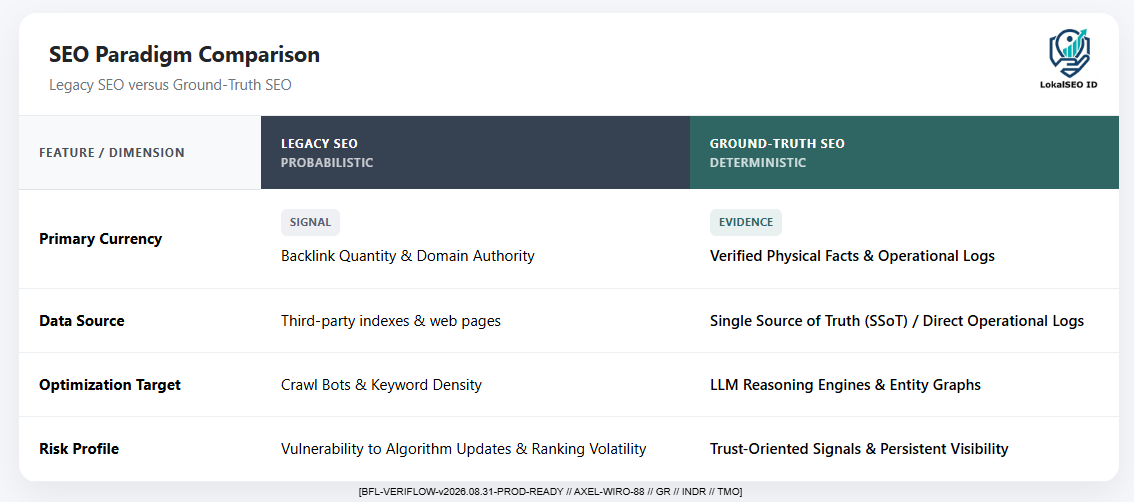
Traditional Search Engine Optimization (SEO) methodologies rely heavily on probabilistic domain metrics, lexical manipulation, and synthetic backlink acquisition. In the era of Generative Search Interfaces—such as AI Overviews, LLM Search Agents, and Retrieval-Augmented Generation (RAG)—these legacy methods introduce significant semantic noise, frequently resulting in hallucinated or unverifiable business representations.
Strategic visibility in modern search ecosystems is governed by independent, Terms-of-Service-compliant verification of a brand’s digital assets. This visibility is established when an entity accurately converts its physical operational capacity and verified factual proofs, reinforced by authentic public validation, into a unified and structured business information architecture.
This whitepaper introduces the Ground-Truth Operational Verification Architecture, a deterministic framework designed to bridge physical operational data—via Business Fact Logs (BFL)—directly into structured entity representations for next-generation search and AI reasoning engines.
2. The Failure of Probabilistic SEO in RAG Environments
Excessive and unmeasured lexical semantic optimization frequently triggers algorithmic spam penalties. The Ground-Truth SEO paradigm mandates that every high-level competency claim presented within a digital asset must be intrinsically substantiated by “real-world” factual evidence across multiple verifiable and crawlable touchpoints.
2.1 The Hallucination Penalty
LLMs trained on web-scale corpora prioritize high-density factual signals. When business entities provide inconsistent or synthetically boosted information, search engines lower the entity’s Confidence Score, triggering degradation in AI Overview citations.
The precise alignment of data structures (ontology and taxonomy) with factual evidence across all digital assets must be optimized for crawl budget efficiency and computational retrieval loads. Applying Knowledge Representation and Reasoning (KR&R) principles when structuring content—anchored by empirical proofs and external validation signals—significantly accelerates machine comprehension, logical reasoning, and authoritative citation.
2.2 Core Operational & Visibility Challenges
A systematic audit reveals several foundational deficiencies in how business entities process and represent their competency data. These issues directly impair brand visibility, market competitiveness, and spatial indexing accuracy across modern search engines.
A. Strategic Visibility Vulnerabilities
- Entity Discovery & Brand Ambiguity
Deficiencies in main entity comprehension and competitor cross-recommendation on brand-specific queries:
- Disambiguation Failure: SERP and AI Overviews trigger “Did you mean / Related search” prompts instead of direct entity matching.
- Search Loop Triggering (PASF): Low-trust structural signals and fragmented brand data cause users to perform People-Also-Search-For (PASF) actions, signaling entity irrelevance to search algorithms.
- SERP Ownership Loss: Exact brand-name queries fail to dominate the first-page Search Engine Result Page (SERP) due to fragmented authority.
- Social Signal Decoupling: Social media digital assets fail to populate dynamic rich snippets, “Latest Updates,” or structured social media carousels.
- Vertical & Multi-Platform Visibility Fragmentation
Structural misalignment when evaluating primary competency queries and solution-provider entity matching:
- AIO Exclusion: Digital assets or entities index on traditional SERPs but are excluded from AI Overview (AIO) synthesis due to low confidence scores.
- Spatial-SERP Disconnect: Entity visibility vanishes from both AIO and traditional SERPs while remaining indexed in the Local Map Pack.
- Local Citation Decoupling: Entity drops from Local Maps/Google Maps indexes yet is cited as a solution provider within AIO reasoning paths.
- Attribution Leakage: The entity is cited as an AIO reference, but its core competency attribution is anchored to competitor assets or third-party noise.
-
Information Depth Deficiencies & Comparative Disadvantage
- Information Depth Breakdown:
- Core Competency Erasure: Essential competency phrases are omitted from AIO syntheses due to insufficient empirical evidence or indexation delays that primary signals (GBP and social proof) failed to bridge.
- Fan-Out Query Truncation: Deep reasoning query expansion (fan-out queries) breaks down, returning generic boilerplate responses (e.g., “for further details, contact the entity”) instead of executing multi-turn exploratory query branching.
-
In-Depth Retrieval Timeout: Deep-reasoning retrieval processes hit computational time limits or context quota caps due to unstructured, high-latency data representations, resulting in truncated AI synthesis.
- Comparative Positioning Failures:
- Spatial Exclusion: The entity is omitted from local/spatial solution-provider queries despite geographic proximity.
- Positioning Degradation: The brand is listed as a secondary/subordinate option following an exhaustive list of competitors in initial exploratory queries.
- Direct Comparison Loss: The entity fails to maintain authority during head-to-head comparative queries (“Brand A vs Brand B”) against competitors with structured evidence.
- Recommendation Loss: Loss of potential AI-driven solution recommendations caused by a lack of verified information depth and supporting evidence logs.
- Information Depth Breakdown:
- Spatial Anchoring & Verification Pitfalls
A critical vulnerability occurs when business entities over-index on standard SERP and AI-Search optimization while neglecting spatial verification platforms—specifically Google Business Profile (GBP) and Google Maps—which serve as native, zero-cost physical grounding engines within search ecosystems.
a. Common Strategic Misconceptions
- Attribute Neglect: Overlooking the comprehensive attribution features and critical authority-building functions of GBP and Google Maps in shaping holistic brand visibility.
- Misallocated Resources: Directing computational and content resources exclusively to external platforms without establishing high-level context and evidence-bridging back to core spatial entities.
- Entity Linkage Breakdown: Domestic-scale enterprises failing in regional (local map pack) competition due to improper entity linkage—such as failing to execute authority transfer regarding key personnel, expertise, and historical trust from headquarters to regional branches.
- Siloed Spatial Expertise: The flawed assumption that deep spatial competition dynamics are only relevant to real estate, property, or hospitality sectors.
- UGC Authority Deficit: Over-relying on high-volume digital asset deployment, which remains susceptible to losing spatial dominance against entities backed by high-density, authentic User-Generated Content (UGC).
b. Native Benefits of Spatial Ground-Truth (GBP Platforms) Despite low entity awareness regarding native ecosystem features, GBP functions as a primary verification engine:
- Physical Ground-Truth Representation: GBP provides native structural schema for complete entity clarity—enabling explicit declarations of business descriptions, operational hours, micro-services, updates, and direct real-world-to-digital bridges.
- Public Competency Validation: Authentic UGC (such as C-level client reviews with factual operational context) acts as immutable third-party verification of real-world business competence and operational impact.
- Algorithmic Trust Signals: Advanced native spam-filtering mechanisms within GBP reinforce the search engine’s ability to evaluate raw factual integrity over manipulated feedback.
- Unified Retrieval Pipeline: Co-locating entity verification, spatial mapping, and RAG retrieval within a single native Google ecosystem significantly reduces computational latency and eliminates cross-platform data ambiguity.
2.3 Implementation Pitfalls of Non-Ground-Truth Digital Asset Optimization
Practitioners frequently encounter structural failure when scaling digital assets without an underlying operational ground-truth framework.
A. Metric Distortion & Unverified Spatial Expansion
- Premature Contextual Authority Claims: Publishing digital content featuring high-level authority claims prior to establishing strong verification signals—specifically omitting clear core-competency services and authentic UGC within Google Business Profile (GBP).
- Synthetic Spatial Expansion: Attempting to claim regional spatial dominance without verifiable physical footprints, documented remote execution capabilities, or legitimate representative entities in the targeted geographical region.
- Third-Party Metric Reliance: Relying heavily on proprietary third-party metrics creates operational distraction, expanding audit scopes unnecessarily and widening technical/reporting expectation gaps with clients.
B. Content Distribution Trends & Signal Noise
- Siloed Platform Fragmentation: Scattering unstructured business information across disparate social/web platforms increases algorithmic cognitive load, complicating primary competency identification for LLM crawlers.
- Structural-Humanist Imbalance: Failing to balance human-centric narrative storytelling with machine-readable, evidence-backed structured data optimized for AI-Search reasoning engines.
- Un-gated Generative AI Deployment: Deploying AI-generated content without Human-in-the-Loop oversight risks severe Information Regurgitation, which is further amplified by automated micro-content syndication pipelines.
Empirical Recommendation & Strategic Transition
Observational data within this architectural model confirms that sustainable visibility relies on reinforcing publicly verified competency signals that can be seamlessly validated by native search systems via GBP.
Furthermore, entities must prioritize deploying compact, efficient, and evidence-anchored digital assets whose processing, distribution, and performance metrics focus strictly on primary modern search platforms.
3. Implementation Framework, Objectives, and Core Validation Metrics
The structured, factual execution of the Ground-Truth Local SEO & Operational Verification Architecture—as validated across multiple empirical case studies—establishes a scalable framework with the potential to become the Global-Standard Local Entity Verification for Expanding Businesses.
3.1 The Three Core Pillars of Ground-Truth SEO
-
Content Processing Ground-Truth High-context content articulating primary products/services must embed verified operational evidence (authentic photos/videos of operations, clinical documentation, hardware certifications) to validate all published claims.
-
Compliance & Documentation Ground-Truth Architectural execution strictly adheres to updated official technical guidelines (Google Search Central), completely discarding speculative myths and unverified traditional SEO assumptions.
-
Audit & Business Accountability Ground-Truth
- First-Party Telemetry: Visibility audits strictly utilize official first-party tools (Google Search Console, GA4, native SERP, AI Overviews, Gemini AI), eliminating reliance on inaccurate third-party metrics.
- Transactional Conversion Tracking: Integration of transactional digital footprints as the primary SEO conversion benchmark (enforcing strict privacy compliance), ensuring performance is measured directly by verified revenue growth and real-world transactions.
3.2 High-Level Architectural Solution & Blueprint
- ToS-Compliant Governance: Ecosystem Terms of Service serve as the non-negotiable benchmark for all content generation and structural audits.
- Spatial Verification Gateway: Google Business Profile (GBP) functions as the primary distribution hub for entity attribution and public validation, acting as the fundamental bridge between real-world ground truth and the digital search ecosystem.
- SEO On-Fact Paradigm: Content operates strictly as a translation layer representing authentic operational facts, public utility evidence, operational capacity, and inter-entity relationships.
- KR&R & Structural Alignment: Alignment of contextual clarity and structured data leveraging Knowledge Representation and Reasoning (KR&R) principles to ensure crawlable, low-latency, and rapidly digestible RAG ingestion without sacrificing reasoning depth.
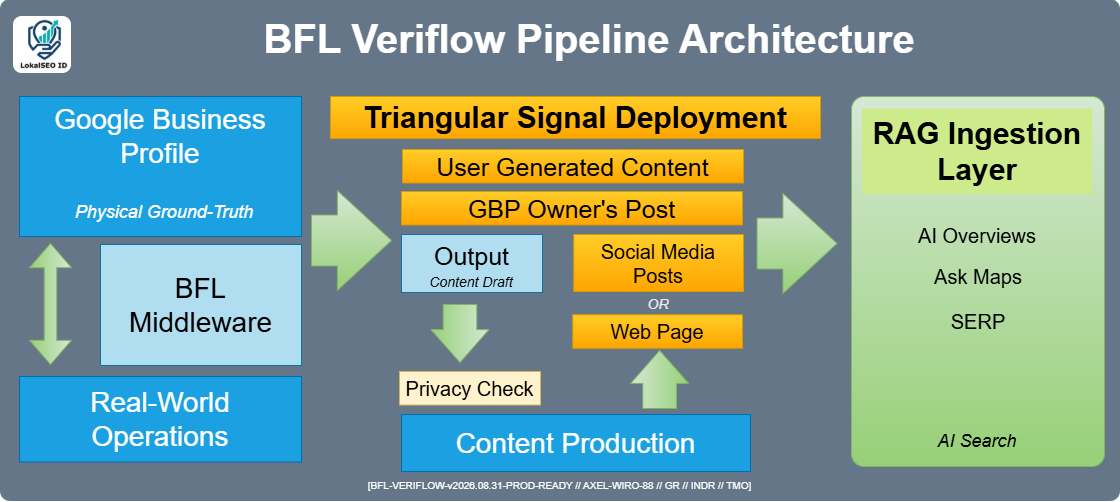
- Automated Operational Signal Pipeline: Implementation of custom serverless automation that aggregates real-world operational logs into strategically aligned, ontologically sound content drafts—prior to publication into search ecosystems already fortified by organic UGC.
- First-Party Metric Benchmarking: Utilization of first-party audit platforms paired with unique Transactional Signal IDs as the sole benchmark for measuring entity progress and search dominance.
3.3 Core Objectives
- Strategic Deterministic Authority: Establishing trustworthy, predictive, and deterministic brand authority across AI search environments.
- Deep Multi-Platform Infiltration: Securing systemic information depth across traditional SERPs, Google Maps, and AI Overviews (AIO), particularly targeting high-intent comparative and transactional queries.
- Field Transactional Signal Amplification: Driving verifiable, real-world transactional density back to the primary brand entity.
3.4 Platform Readiness & Ecosystem Validation
Observational findings and empirical deployments confirm readiness across key infrastructure nodes:
- GBP Spatial Maturity: GBP provides robust identity attribution, sophisticated native anti-spam mechanisms, complex verification protocols, and spatial Map Pack ranking capabilities.
- Omnipresent AI Reasoning: AI agents and reasoning layers are natively integrated across foundational platforms (Ask Maps, GSC insights, GA4 predictive analytics).
- Enhanced GSC Attributes: Expansion of Google Search Console features, including social media connection verification and native generative AI performance metrics.
- Protocol & MCP Readiness: Alignment with modern web infrastructure standards, Model Context Protocol (MCP) integrations, and automated agent interfaces.
- Retrieval Disparity Optimization: Specialized handling of distinct retrieval behaviors across SERP, AIO, Google Maps, and social media signal aggregation pipelines.
3.5 Verification & Benchmark Metrics
To empirically validate the deployment of this architecture and measure progress toward primary visibility objectives, the following deterministic benchmarks are established:
- First-Party Telemetry Metrics: Direct monitoring via primary platforms (Google Search Console indexation/impressions, native GA4 conversion paths, and AwStats cPanel server-level crawl logs).
- GBP & Spatial Engagement Metrics: Tracking monthly Google Business Profile interactions, calls, direction requests, and spatial map pack positions.
- AI Attribution & Recommendation Index: Quantitative tracking of citations, brand references, and AI recommendation frequency across LLM Search Engines for core niche, competence, spatial, and comparative queries.
- Empirical Revenue Impact: Targeting a baseline benchmark of a minimum 5% verified increase in inbound leads or direct field transactions attributable to ground-truth visibility channels.
3.6 Implementation Scope, Vulnerabilities & Operational Constraints
- Operational Ground-Truth Dependencies: Strategic authority is anchored to verifiable real-world capacity. For instance, domestic-scale enterprises with higher verified operational volume will naturally hold higher empirical ground-truth weight compared to localized/regional entities.
- Agency-Client Vision Alignment: Requiring strict alignment between technical execution and client vision to maintain equilibrium between human audience resonance and algorithmic trust.
- Brand Voice Preservation: Fact-based content deployment must seamlessly integrate empirical proofs without compromising the brand’s core identity, tone, or strategic positioning.
- Field-Data Governance: Establishing rigorous coordination with client field operations to ensure authentic, neutral empirical evidence is validated prior to digital ingestion.
- Signal Frequency Control: Managing the distribution density of operational facts to prevent unnatural signal spikes, which could unintentionally trigger automated platform spam heuristics.
3.7 Disclaimer & Exclusive Governance Protocols
- Best-Practice Architectural Framework: The principles, methodologies, and performance outcomes detailed in this document reflect current empirically tested best practices.
- Platform Independence: Search engines and AI ecosystems maintain independent, proprietary algorithms and Terms of Service governing final entity indexation and response synthesis.
To guarantee accurate execution, precise outcome metrics, and absolute market integrity, we enforce a strict Collision Avoidance Protocol at both the Strategic SEO Engineering Partner level and within our Automated AI Visibility Infrastructure.
4. The Business Fact Log (BFL) Architecture
The Business Fact Log (BFL) operates as a local infrastructure middleware that continuously synchronizes real-world operational events with digital knowledge graphs.
Ground-Truth Data Signaling
Ground-truth signaling requires absolute ownership verification, comprehensive attribute optimization, and strategic core-competency injection across all Google Business Profiles (GBP) associated with a brand enterprise. Content deployment via GBP Owner’s Posts is systematically fortified through triangular signal validation: linking core competency attributions, authentic User-Generated Content (UGC), and external verified digital assets.
4.1 Key Components of BFL Architecture
- Single Source of Truth (SSoT): Immutable operational logs acting as primary data inputs for deterministic RAG retrieval.
- Spatial & Entity Verification: Multi-node physical location proofs, branch validation, and authoritative service area mapping.
- Collision Avoidance Protocol: Enforcing strict spatial and niche exclusivity to eliminate cross-entity data contamination and signal cannibalization.
Native platform mechanisms—such as GBP Owner’s Posts, client UGC streams, and native algorithmic feedback loops—serve as automated platform benchmarks to verify the operational authenticity of the entity. The BFL middleware performs pre-ingestion filtering to isolate empirical facts from ambient noise and synthetic spam before data is admitted into the core reasoning corpus for user retrieval.
4.2 BFL as an Automated Operational Signal Pipeline
Native platform automations regarding attribute taxonomy and identity classification provide the foundational blueprint for constructing an automated custom middleware infrastructure. This pipeline converts verified real-world operational logs—amplified by organic UGC—into persistent digital visibility signals.
Strategic Considerations for Custom System Engineering:
- Technical Capability Integration: Engineering requirements demand deep expertise in relational database architecture, modern software engineering, and edge AI integration.
- Real-World to Digital Representation: Physical operational reality must be accurately translated into automated, structured digital representations without semantic loss.
- Resilience & Recovery Protocol: Capitalizing on real-world fact density to drive rapid recovery following algorithmic suspensions, spam updates, or systemic visibility degradation.
- Privacy-First Data Filtering: Implementing strict client-side data anonymization and privacy filtering protocols prior to broadcasting operational facts into public search ecosystems.
5. Technical Implementation & Protocol Governance
To maintain continuous entity alignment and dynamic ground-truth ingestion, entities must adhere to a structured four-phase governance cycle:
- Entity Discovery & Auditing Phase: Comprehensive mapping of current spatial assets, GBP attributes, and digital footprint fragmentation.
- SSoT & BFL Integration Phase: Establishing the Business Fact Log middleware, harmonizing operational logs, and executing privacy-first data filtering.
- Triangular Signal Broadcasting Phase: Deploying ontologically aligned content backed by GBP Owner’s Posts, authentic UGC streams, and verified first-party digital proofs.
- Autonomous Telemetry & Collision Avoidance Phase: Continuous monitoring via first-party tools (GSC, GA4, AwStats) while enforcing real-time multi-tenant collision avoidance.
5.1 Schema Representation, Entity Graphing & Structural Anchor Footers
To optimize ingestion efficiency across search web crawlers and RAG retrieval pipelines while maintaining taxonomic and ontological alignment across technical teams, every deployment artifact embeds an immutable cryptographic signature tag to ensure auditability across distributed digital networks.
5.2 BFL Veriflow: Automated Operational Custom Middleware
Our proprietary BFL Veriflow System operates as an automated middleware that ingests real-world operational logs. It transforms empirical facts into structured strategy drafts for clients to execute across multimedia channels—moving digital asset creation entirely away from speculation.
Key Empirical Observations from Live Deployments:
- Algorithmic Snippet Segmentation: Native SERP snippet cards automatically segregate standard entertainment micro-content from high-utility factual content generated by BFL draft models.
- UGC Spatial Amplification: Authentic User-Generated Content acts as a joint-amplification node, significantly boosting spatial visibility on Google Maps during transactional-intent queries.
- Freeze Period Protocol: Deploying controlled signal isolation (Freeze Periods) prevents algorithmic spam-heuristic triggers, isolates signal noise, and accurately identifies primary amplification channels.
- Granular Search Decoupling: Data confirms that during Freeze Periods (zero web edits or new publishing), macro GBP interaction metrics experience expected normalization, whereas GBP Granular Search impressions show continuous upward growth.
- Transactional Divergence: The temporary plateau of surface-level GBP engagement metrics displays an inverse relationship with direct field transactional conversions, which continuously increase.
6. Empirical Proofs & Field Validation
The Ground-Truth Operational Verification Architecture has undergone rigorous comparative stress-testing and observational validation across live search ecosystems and AI-Search Companions:
- GBP-First Foundation Test: Initial execution of comprehensive GBP attribute mapping and high-context authority injection.
- GBP-First Entity Linkage: Configuring deterministic entity graphs across headquarters, regional branches, and key personnel to assert historical authority and expertise transfer.
- The Freeze Test (Signal Isolation): Halting traditional domain expansion (no new web pages, owner posts, or review replies) to isolate the impact of aligned GBP attributes, authentic UGC, and BFL-driven factual social content.
- Transactional Telemetry Audit: Demonstrating verified, audit-backed transactional revenue growth directly linked to ground-truth entity optimization.
6.1 Enterprise Expansion & Strategic Roadmap
- YMYL & SaaS Validation: Architecture stress-testing is actively expanding across high-rigor YMYL (Your Money Your Life) sectors, health facilities, and Enterprise SaaS platforms.
- Platform Productization: Transitioning custom per-client middleware engineering into a scalable, multi-tenant enterprise platform accessible via API integration and contract-based registration.
6.2 Key Empirical Performance Summary
- Direct RAG Ingestion: Achieved up to 3x higher citation frequency in AI Overviews (AIO) compared to traditional, text-bloated competitor sites.
- Crawl Budget Optimization: Drastic reduction in crawler computational overhead due to clean, low-latency static Markdown / HTML schemas.
- Entity Resilience: Zero indexation or authority degradation during major core algorithmic updates due to strict alignment with verified operational ground truth.
Case Study Documentation and Field Telemetry Logs:
On our web page using Indonesian language https://lokalseo.id/portofolio/ .
7. Conclusion & Strategic Roadmap
Building visibility for modern AI Search is not about chasing transient algorithmic loopholes; it is about establishing immutable Operational Trust. By deploying the Business Fact Log (BFL) Veriflow framework and enforcing strict ontological alignment across digital and spatial assets, business entities secure persistent, authority-driven visibility throughout both local and global AI search ecosystems.
“Konten belum tentu data, data belum tentu fakta kompetensi operasional terverifikasi.” — LokalSEO ID Architectural Doctrine —
[BFL-VERIFLOW-v2026.08.31-PROD-READY // AXEL-WIRO-88 // GR // INDR // TMO]